Table of Contents
- 01The three classes at a glance
- 02Class 1: pedal assist to 20 mph
- 03Class 2: a throttle
- 04Class 3: pedal assist to 28 mph
- 05What the class does not limit
- 06Where the three-class system applies
- 07The federal definition
- 08Where each class can ride on public land
- 09The class label
- 10Bikes that switch classes
- 11When it is not an e-bike anymore
- 12Which class should you buy?
- 13FAQ
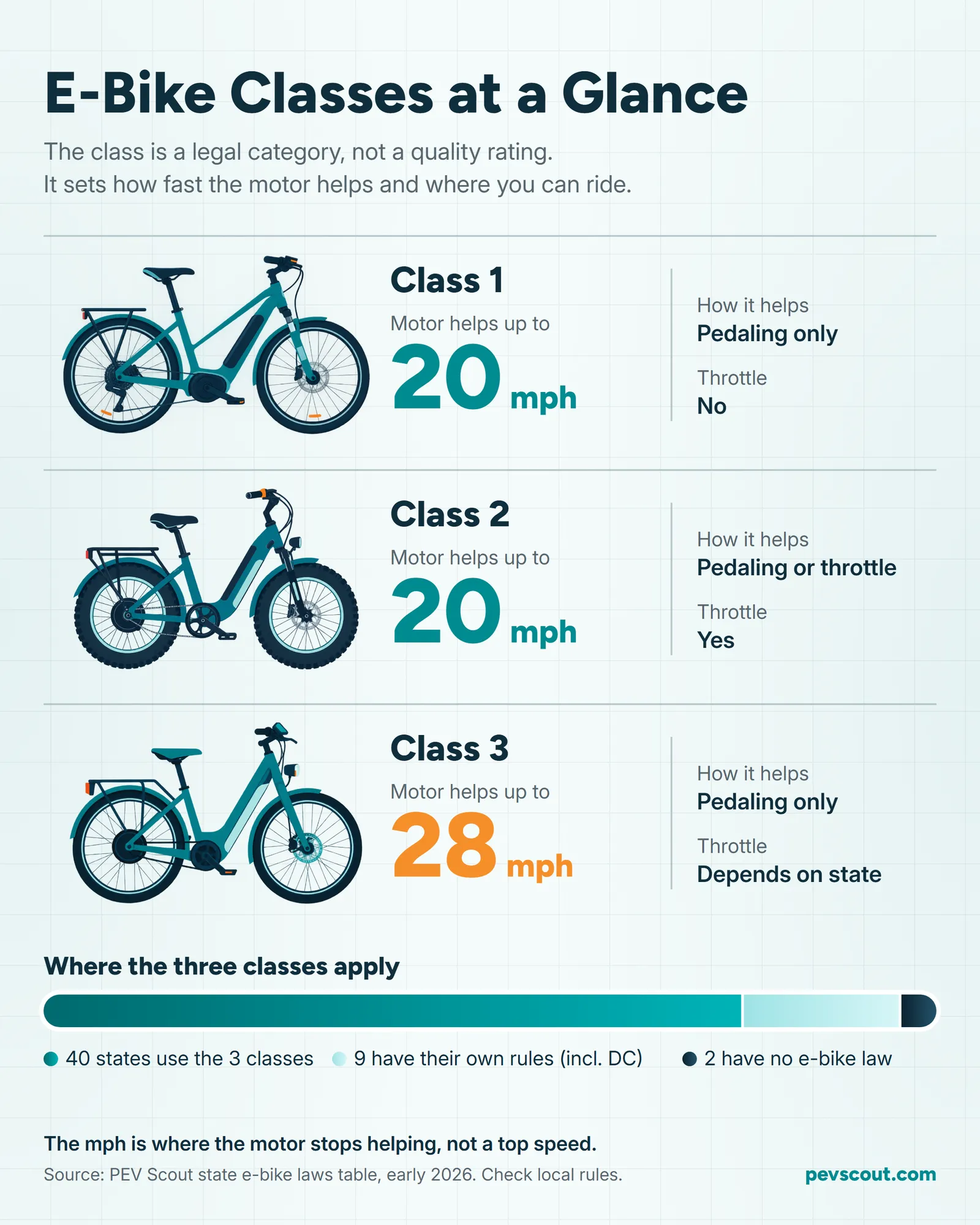
The class on an e-bike is not a quality rating. It is a legal category, and it answers three questions: how fast the motor will help you, whether the bike can move on the motor alone with a throttle, and where you are allowed to ride it. Two bikes that look identical can land in different classes, and that difference decides whether you can take the one on your local bike path.
This guide explains the three classes, what they do and do not limit, where the rules change from state to state, and how to pick the class that fits how you ride. The state figures come from the e-bike laws table in our tools, which lists every state and was last checked in early 2026. Laws change, so confirm with your state before you rely on any single rule.
The three classes at a glance
| Class | How the motor helps | Motor stops helping at | Throttle |
|---|---|---|---|
| Class 1 | Only while you pedal | 20 mph | No |
| Class 2 | While you pedal, or on the throttle alone | 20 mph | Yes |
| Class 3 | Only while you pedal | 28 mph | Depends on the state |
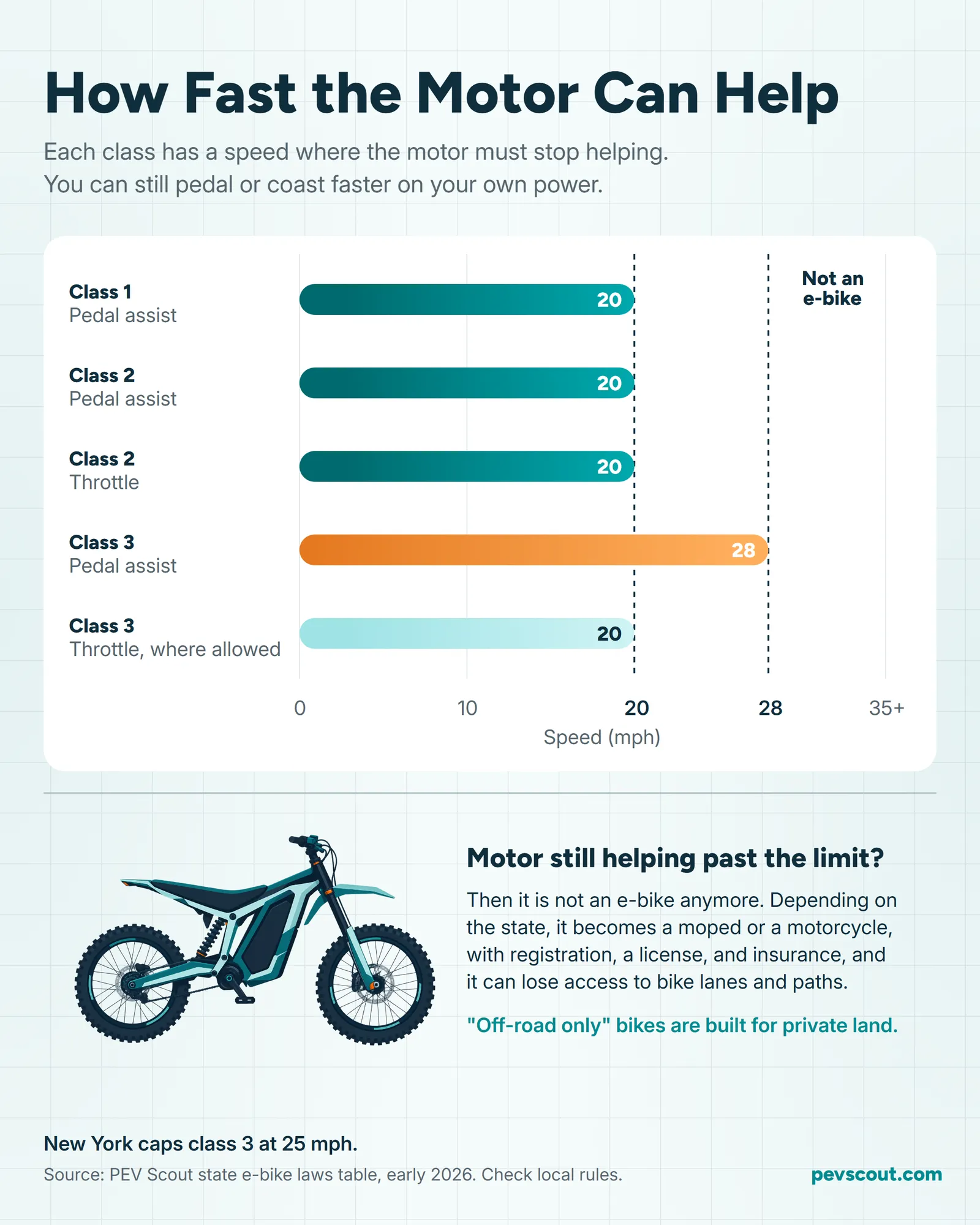
The speed in each row is the point where the motor stops adding power, not a top speed. You can pedal any e-bike faster than its limit, and you can coast faster downhill. Above the limit, it is simply a bicycle with a heavy battery on it.
Class 1: pedal assist to 20 mph
A class 1 e-bike only helps while you are pedaling, and the help fades out at 20 mph. There is no throttle. It is the class that is most like a regular bicycle, and that is its advantage: in most places a class 1 e-bike can go anywhere a regular bike can, including many paved paths and a growing number of mountain bike trails.
Class 1 suits riders who want exercise with a tailwind, trail riders, and anyone whose local paths or trails only admit class 1. It is also the class land managers are most comfortable with, so when a park or trail system opens up to e-bikes, class 1 is usually first in line.
Class 2: a throttle, still capped at 20 mph
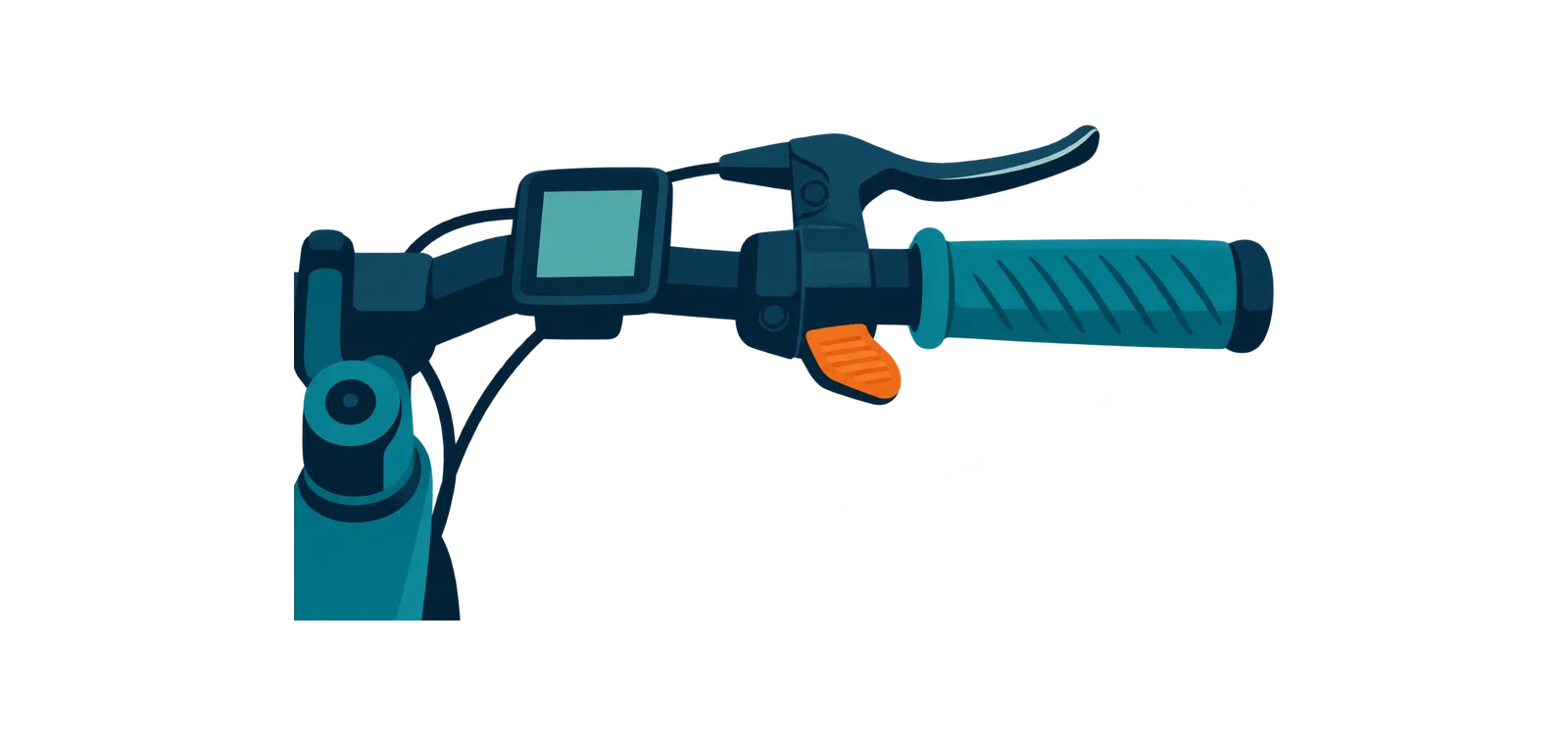
A class 2 e-bike adds a throttle. You can ride it on the motor alone, with no pedaling at all, up to 20 mph. It usually has pedal assist as well, also capped at 20 mph.
The throttle is the reason most people choose class 2. It helps you pull away from a stop sign with a heavy load, get started on a hill, rest a sore knee, or keep moving on a day your legs are done. It is common on cargo bikes, fat tire bikes, folding bikes, and trikes. Our list of the best electric bikes with throttle covers the ones worth buying.
Where class 2 is limited is off-road. Many mountain bike trails that allow e-bikes allow class 1 only, because a throttle lets a rider move without pedaling, and trail groups see that as a motor vehicle.
Class 3: pedal assist to 28 mph
A class 3 e-bike helps while you pedal, all the way to 28 mph. That extra 8 mph is the difference between keeping pace with city traffic and being passed by it, which is why class 3 is the commuter's class.
The extra speed comes with extra rules in most states:
- A speedometer. The model law most states copied requires one on class 3 bikes.
- Age limits. Many states set 16 as the minimum age to ride class 3.
- Helmets. Several states require a helmet on class 3 at any age, including California and New York, and a few require one for all riders under 21.
- Paths. Class 3 is often not allowed on shared bike and walking paths unless the local authority opens them, so a class 3 commuter can end up on the road where a class 1 rider stays on the path.
Under that model law, the class 3 motor only helps while you pedal. Many bikes sold as class 3 still ship with a throttle that cuts out at 20 mph. Whether that throttle is allowed depends on your state, so check before you count on it.
If you ride class 3 speeds, the helmet matters more than the paperwork. A standard bicycle helmet is tested for impacts at bicycle speeds; our e-bike helmet guide covers the ones tested for faster riding.
What the class does not limit
The classes cap how fast the motor helps. They mostly do not cap how strong it is.
- Power. Many states write a 750 watt limit into their e-bike definition, matching the federal product definition below. Others have dropped the watt cap entirely; Oregon removed its caps in 2025, for example. A 750 watt limit usually refers to the rated (continuous) power, so a bike can list a higher peak figure and still be within it.
- Torque. Nothing in the classes limits torque, which is what you feel on a hill. A class 1 mid-drive with high torque can climb better than a class 2 hub motor with a bigger watt number.
- Range and battery size. No class limits them.
So two class 2 bikes can feel completely different. The class tells you where you can ride; the motor, battery, and torque tell you how it rides.
Where the three-class system applies
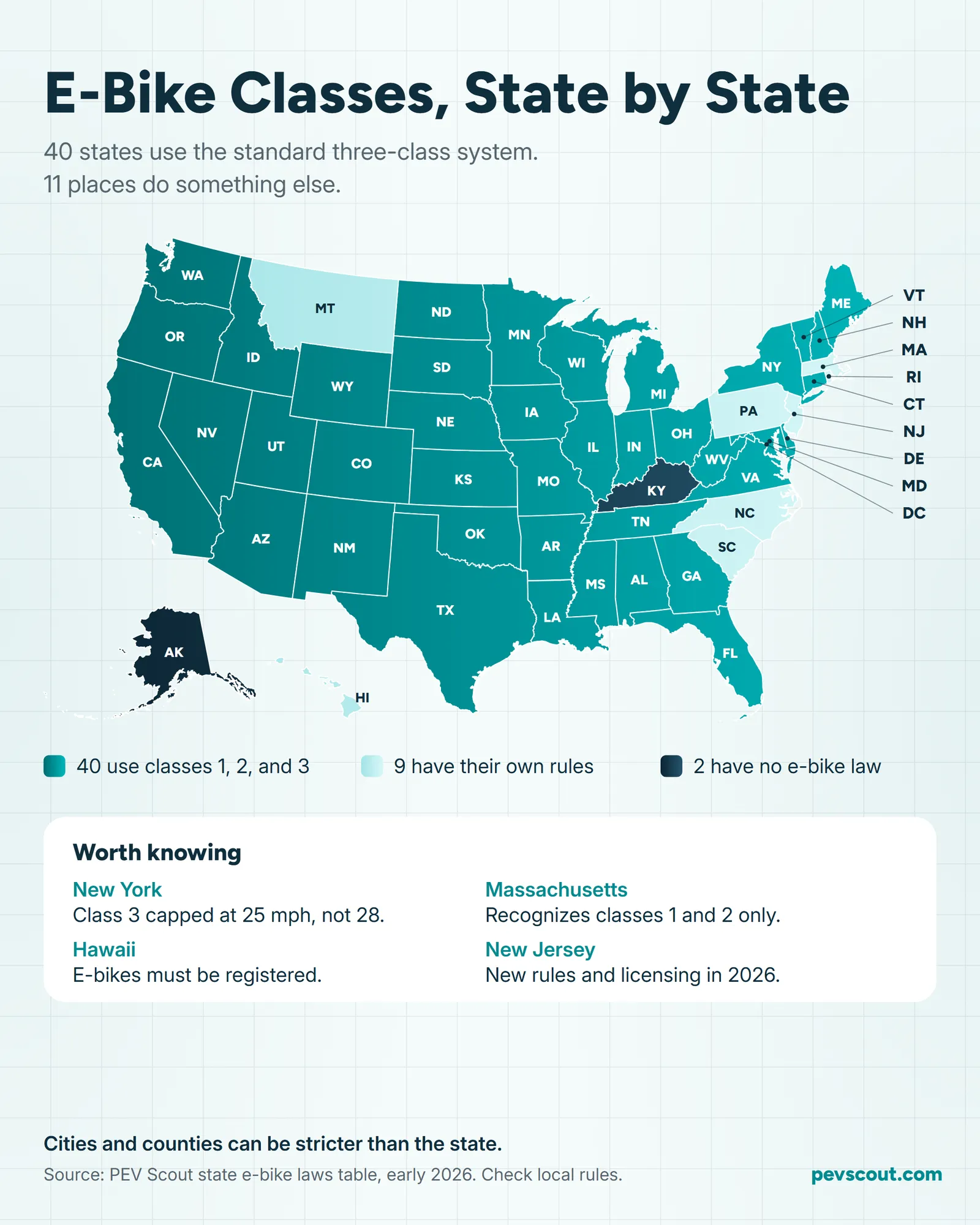
The three classes are not federal law. Each state decides. According to our state table, as of early 2026:
- 40 states use the standard three-class system.
- 9 places have their own rules: Hawaii, Massachusetts, Montana, New Jersey, North Carolina, Pennsylvania, Rhode Island, South Carolina, and Washington DC.
- 2 states have no e-bike law at all: Alaska and Kentucky, where the federal definition and local rules fill the gap.
A few differences are worth knowing even inside the three-class states. New York caps class 3 at 25 mph rather than 28, and New York City has its own lower city speed limit. Massachusetts recognizes only classes 1 and 2, so a class 3 bike there may be treated as a moped. Hawaii requires registration. New Jersey rewrote its rules in 2026 with its own categories, licensing, and registration.
Cities and counties can be stricter than the state, especially about sidewalks and park paths. The state laws table lists each state's speeds, age limits, helmet rules, and sidewalk rules in one place.
The federal definition, and what it is for
Federal law defines a low-speed electric bicycle as a two- or three-wheeled vehicle with working pedals, a motor under 750 watts, and a top speed under 20 mph on the motor alone with a 170 pound rider. That definition is about product safety: it makes these bikes consumer products under the Consumer Product Safety Commission rather than motor vehicles.
It does not tell you where you can ride. Road and path rules come from your state and city, which is why the classes, not the federal definition, are what matter day to day.
Where each class can ride on public land
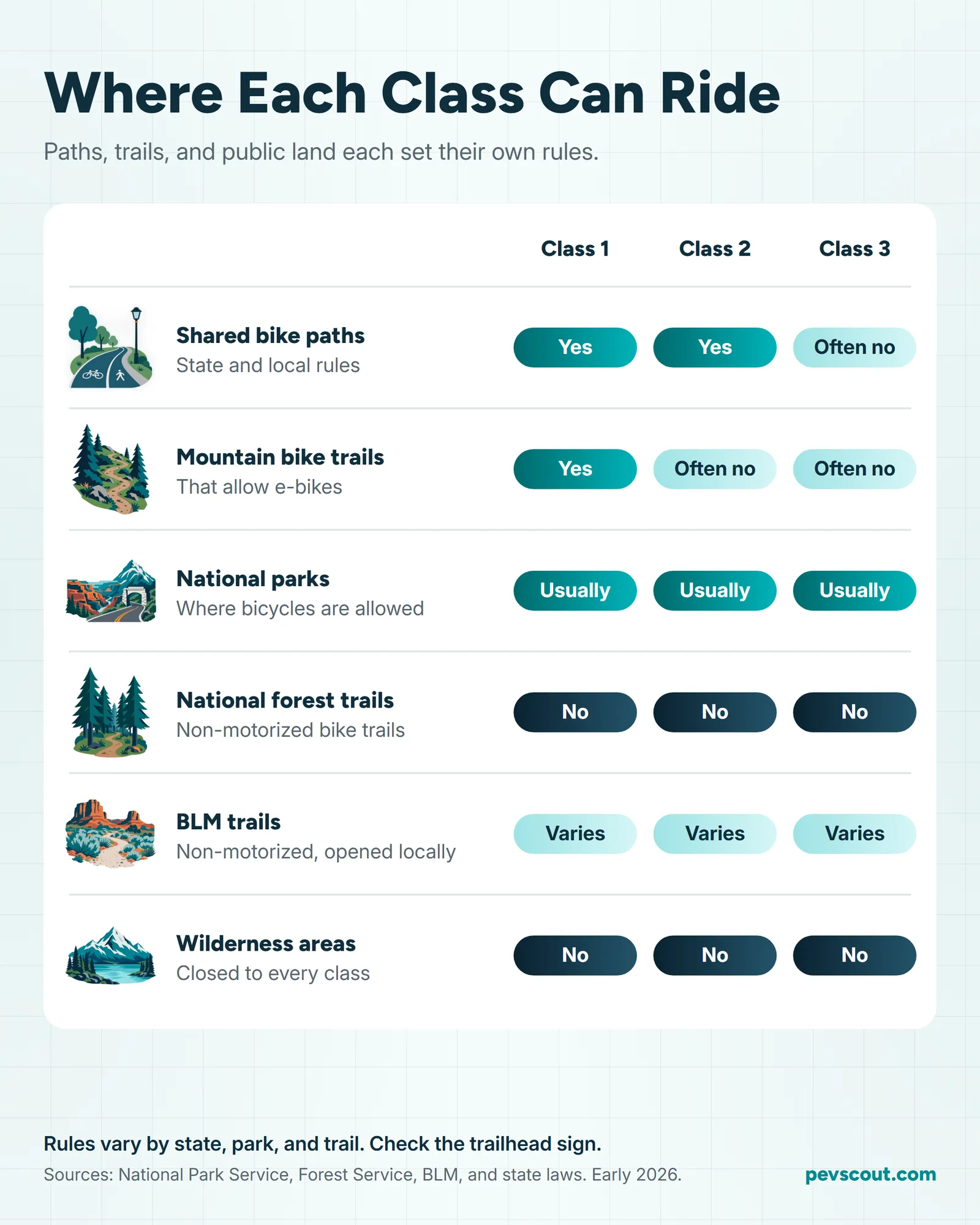
Federal land managers each set their own rules, and they are not the same:
- National parks generally allow e-bikes where regular bicycles are allowed, and each park's superintendent can limit that. Hiking-only trails stay closed.
- National forests treat e-bikes as motor vehicles. They are allowed on roads and trails open to motor vehicles, and on trails specifically designated for e-bikes, but not on regular non-motorized bike trails.
- Bureau of Land Management land can open non-motorized trails to e-bikes through local decisions, and local offices can limit that to class 1. The Moab field office, for example, allows only class 1 on its designated non-motorized trails from March 2026.
- Wilderness areas are closed to all e-bikes, whatever the class.
State parks, city parks, and private trail networks set their own rules on top of these. When in doubt, check the trailhead sign or the land manager's website before you ride.
The class label
In most three-class states, a manufacturer has to put a permanent label on the bike showing its class, its top assisted speed, and its motor wattage. The label is how a ranger, an officer, or a trail steward tells the classes apart, so it matters if you are ever stopped.
If you are buying used, look for the label. A bike with no label, or one with a label that does not match how it rides, can be hard to defend.

Bikes that switch classes
Many e-bikes let you change settings in the display or an app, for example switching between class 2 and class 3 modes, or turning the throttle on or off. That is legitimate when the bike was built and labeled to do it. Ride it in the mode that matches where you are: class 2 mode on the bike path, class 3 mode on the road where it is allowed.
What changes the picture is removing the limits entirely. If the motor keeps helping past 28 mph, or the throttle works past 20 mph, most states no longer treat the bike as an e-bike at all.
When it is not an e-bike anymore
A vehicle that goes past the class limits on its motor, or that has a motor over the state's power limit, falls outside the e-bike rules. Depending on the state, it becomes a moped, a motor-driven cycle, or an electric motorcycle, and that can bring registration, a license, insurance, and a helmet law with it. It can also lose access to every bike lane and path.
This is common with fast, high-power bikes sold as "off-road only". They are built for private land and dedicated trails, and riding them on public roads without registration is where owners get into trouble. If a listing says off-road use only, take it at its word.
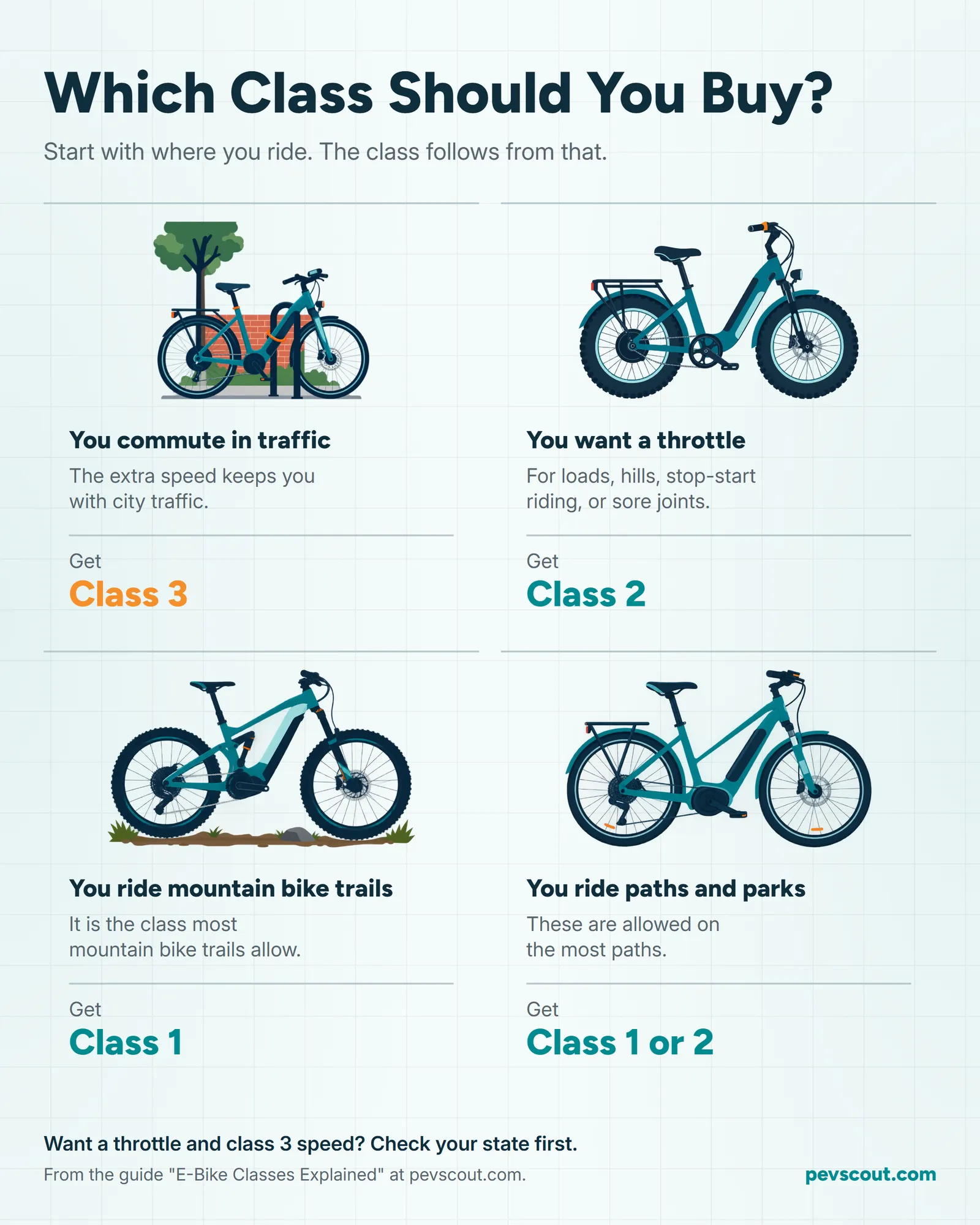
Which class should you buy?
- You commute on roads with traffic: class 3. The extra speed keeps you with traffic and cuts journey times, as long as your route does not depend on paths that exclude class 3.
- You want a throttle for heavy loads, hills, stop-start riding, or sore joints: class 2. Check whether a class 3 bike with a 20 mph throttle is legal in your state if you want both.
- You ride mountain bike trails: class 1, because it is the class most trails admit.
- You mostly ride paths and park loops: class 1 or 2, which are allowed on the most paths.
If you are still deciding on the bike itself, our guide on how to choose an electric bike walks through the specs that matter once you know your class.
Frequently Asked Questions
What is the difference between class 1, 2, and 3 e-bikes?
Do class 3 e-bikes have a throttle?
Can I ride a class 2 e-bike on mountain bike trails?
Do I need a license or registration for an e-bike?
Is there a wattage limit on e-bikes?
Can I change my e-bike's class?
Now See What We Picked
You know what to look for. These are the models that hold up against it.
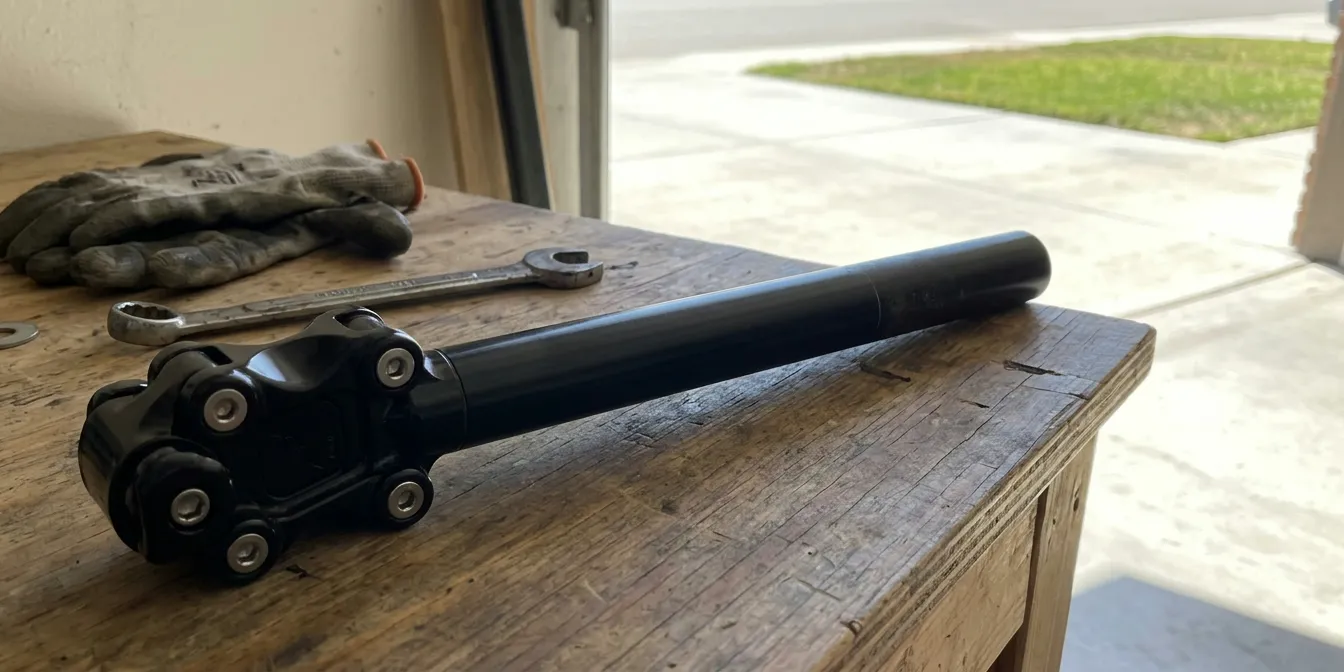 The Best Suspension Seatposts for E-BikesMost e-bikes have no rear suspension, so every pothole goes up the seatpost. These are the linkage posts reviewers and owners rate highest, with the rider limits and measurements to check first.
 The Best Comfort Saddles for E-BikesE-bike riders sit upright and stay seated, so the saddle takes the whole ride. These are the comfort saddles reviewers and owners rate highest, sorted by how upright you sit.
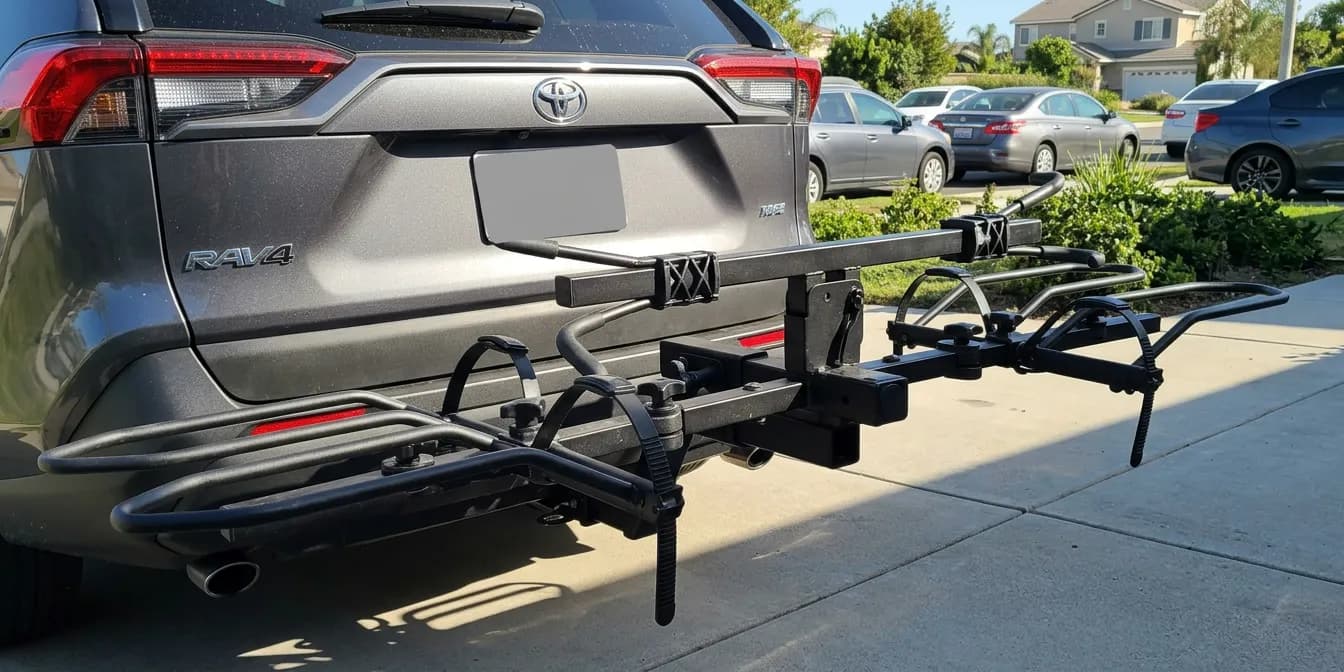 The Best Car Racks for Electric BikesMost car bike racks were built for 35 lb bicycles. These eight hitch racks are rated for what an e-bike actually weighs, from 65 to 100 lbs per bike, with ramps, fat-tire trays and RV approvals where you need them.
Looking to buy an electric ride?
We track 378 vehicles and check their prices every day. Start wherever suits you.
Type
Budget