Table of Contents
- 01How we picked
- 02Quick overview
- 03Our picks
- Best Overall
- Best Smart Helmet
- Best Value
- Best for Class 3 Commuting
- Best Budget Helmet
- Best for Class 1 and 2 Riding
- Most Certified
- Best for Everyday Street Riding
- 04How to choose
- Most "top rated" helmet lists are quoting scores that no longer exist
- What is MIPS?
- The certifications
- Getting the fit right
- Match the coverage to how your vehicle throws you
- Ventilation is a real trade
- Lights, turn signals and smart helmets
- The cheap smart helmets you will find on Amazon
- Lock ports and crash replacement
- When to actually replace a helmet
- Do you need a full-face?
- 05FAQ
A helmet is the one accessory with no argument on the other side. Everything else on this site is a trade-off between money, weight and convenience. This one is not.
The complication for PEV riders is that most bicycle helmets were designed around a rider doing 12 to 15 mph under their own power. A Class 3 e-bike does 28. Crash energy rises with the square of speed, so a 28 mph impact carries roughly four times the energy of a 14 mph one. Most e-scooter riders are well served by the same helmets, but a one-wheel or electric unicycle throws you forward with no handlebars to catch you, and for those riders the better answer is usually a chin bar, which our full-face helmet guide covers. The certification on the sticker was written for the slower case, and that gap is what the picks below are chosen around.
One more thing you should know before you read any helmet list, including this one.
How we picked
Star ratings and ranks are Virginia Tech's, pulled in September 2026 on their current post-July-2025 scale. Every pick holds 4 or 5 stars, the level Virginia Tech recommends, which is why this page has no skate helmets. Certifications, weights and features are each maker's published specifications. Prices move constantly and are indicative only.
We have not run impact tests, and nobody should trust a website that claims it has without a lab behind it. Where a rating comes from an independent testing programme rather than the maker, we say so, and where a helmet has never been independently tested we say that too rather than leaving a gap you might read as a pass.
Quick Overview
We may earn a commission when you buy through links on this page, at no extra cost to you. As an Amazon Associate, we earn from qualifying purchases. Learn more
| Category | Best Overall | Best Smart Helmet | Best Value | Best for Class 3 Commuting | Best Budget Helmet | Best for Class 1 and 2 Riding | Most Certified | Best for Everyday Street Riding |
|---|---|---|---|---|---|---|---|---|
| Pick |  Specialized ModeTop pick |  UNIT 1 AuraBest smart helmet |  Specialized Tactic 4Best value |  UNIT 1 NEON MIPS | 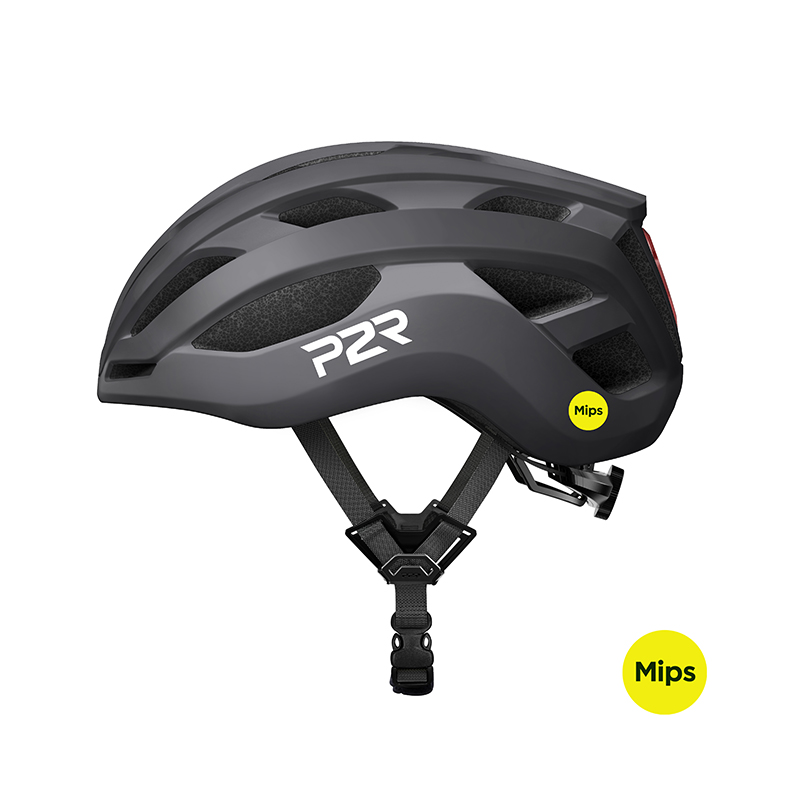 P2R A20 MIPSBudget pick |  MET Downtown MIPS | 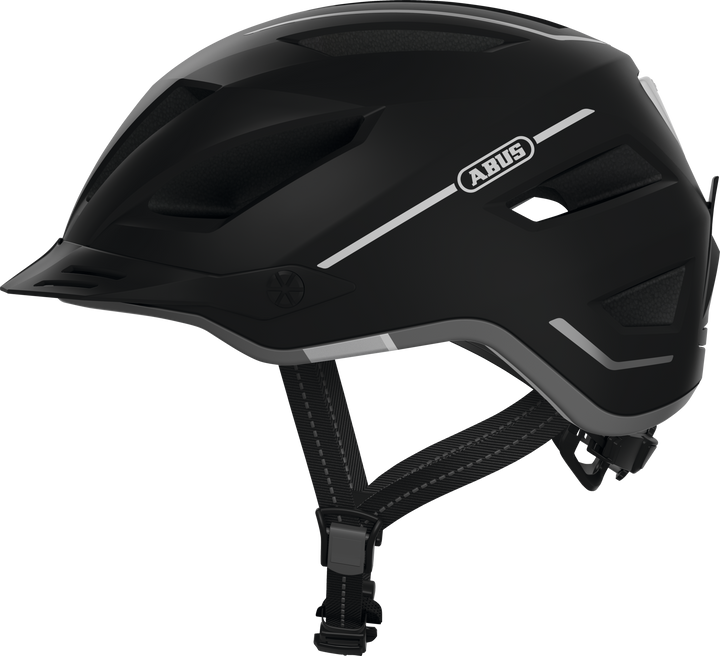 ABUS Pedelec 2.0 MIPS |  Thousand Chapter MIPS |
| Virginia Tech | 5 stars (#23 of 311) | 5 stars (#26 of 311) | 5 stars (#18 of 311) | 5 stars (#39 of 311) | 5 stars (#10 of 311) | 5 stars (#50 of 311) | 4 stars (#90 of 311) | 4 stars (#157 of 311) |
| Certification | CPSC + NTA 8776 | CPSC + EN 1078 + NTA 8776 | CPSC + NTA 8776 | CPSC + EN 1078 + NTA 8776 | CPSC + CE | CPSC + CE + AS/NZS | CPSC + EN 1078 + NTA 8776 + ASTM | CPSC + EN 1078 |
| Integrated light | No, Stix compatible | Front and rear LED, turn signals, brake light | No | Integrated rear LED, signals with remote | Removable rechargeable rear LED | No, reflective rear decal | Rear LED | Magnetic rear light included |
| Style | Urban | Urban | Trail / e-MTB | Urban | Road | Trekking / commuter | Urban | Urban |
| Buy | Buy | Buy | Buy | Buy | Buy | Buy | Buy | Buy |
Our Picks
Best Overall
Specialized Mode
- Virginia Tech
- 5 stars (#23 of 311)
- Certification
- CPSC + NTA 8776
- Integrated light
- No, Stix compatible
- Style
- Urban
Standouts
- 5 stars on the current Virginia Tech scale, ranked 23 of 311
- NTA 8776 certified for 28 mph riding
- The cheapest urban helmet carrying both of those
- MIPS, and ready for ANGi crash detection
Trade-offs
- No integrated light
- Not available on Amazon
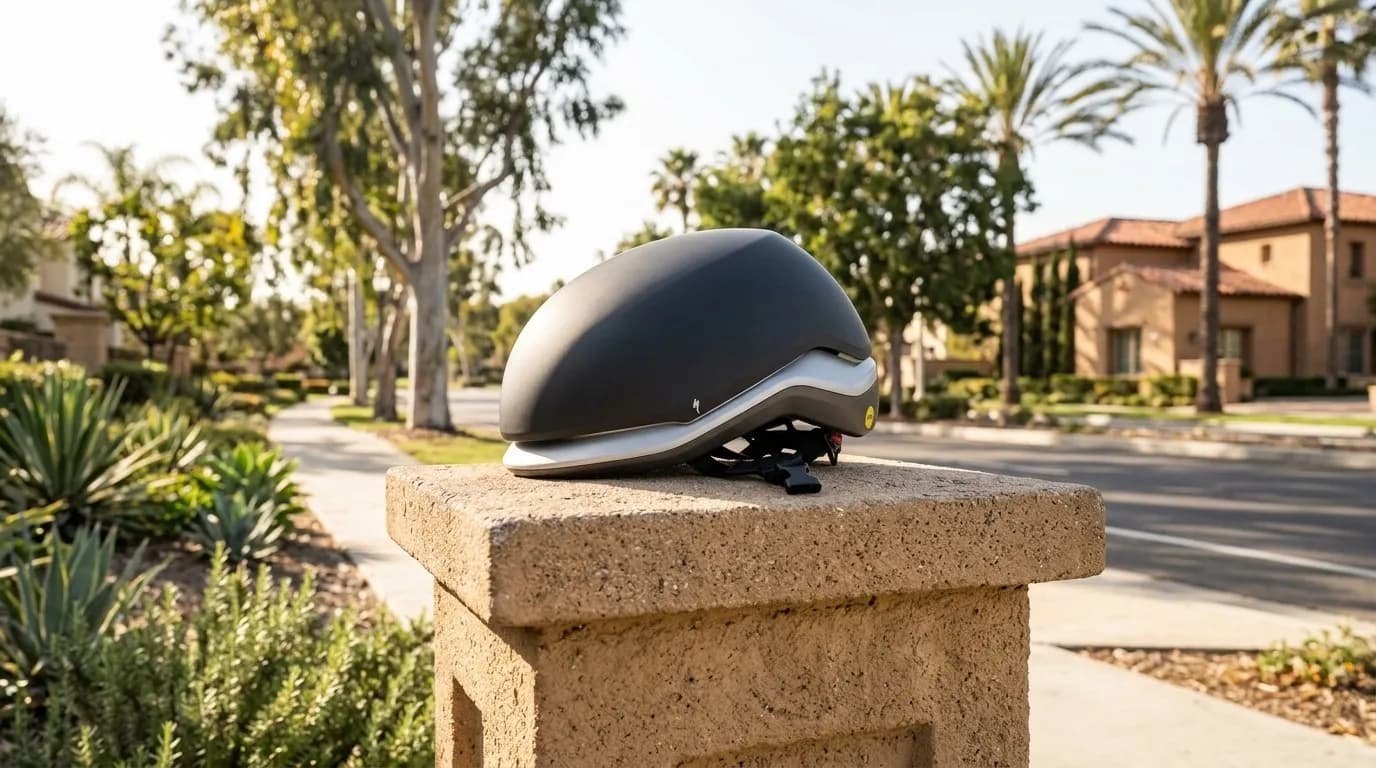
The Mode satisfies both things a PEV rider should care about at the same time, and it is close to the only helmet that does. It passes NTA 8776, the Dutch standard written specifically for 28 mph riding, and it holds a current 5-star Virginia Tech score, ranked 23rd of the 308 helmets they have tested. Most helmets have one or the other.
It is also, at around $120, the cheapest urban helmet carrying both. What you give up is integrated lighting, which the UNIT 1 and the ABUS include, and Specialized does not sell through Amazon, so you are buying from a dealer or direct. If you want one helmet chosen on evidence rather than looks, this is still it.
Best Smart Helmet
UNIT 1 Aura
- Virginia Tech
- 5 stars (#26 of 311)
- Certification
- CPSC + EN 1078 + NTA 8776
- Integrated light
- Front and rear LED, turn signals, brake light
- Style
- Urban
Standouts
- 5 stars and NTA 8776 at the same time
- Turn signals plus an automatic brake light
- Crash alert through the app
- Up to 30 hours of light per charge, claimed
Trade-offs
- About twice the price of the Specialized Mode
- The handlebar remote is sold separately on some listings
Until recently, wanting turn signals meant accepting a helmet that scored badly. The Aura ends that trade. It is one of only five urban helmets holding a current 5-star Virginia Tech rating, and it is the only one of those five with signals, a brake light and crash detection built in.
The brake light triggers off a gyroscope and accelerometer rather than a button, the turn signals run from a handlebar remote, and UNIT 1 claims up to 30 hours of light per charge. It carries NTA 8776 and MIPS underneath all of it. The catch is price: roughly double the Mode, and on some listings the handlebar remote is a separate purchase, so check what is in the box.
Best Value
Specialized Tactic 4
- Virginia Tech
- 5 stars (#18 of 311)
- Certification
- CPSC + NTA 8776
- Integrated light
- No
- Style
- Trail / e-MTB
Standouts
- Best measured score of any NTA 8776 helmet under $200
- Ranked 18 of 311 helmets tested
- MIPS Evolve
- Deeper rear coverage than a road shell
Trade-offs
- Mountain bike styling with a visor, not a commuter look
- No integrated light
At around $110 this is the highest-scoring NTA 8776 helmet under $200 that Virginia Tech has tested, ranked 18th of 311 overall. Nothing else in the dataset gets close to that combination of price, certification and measured performance.
The only reason it is not the outright top pick is shape. It is a trail and e-MTB helmet, with a visor and a silhouette that reads as mountain bike rather than commuter, and there is no integrated light. If you do not mind how it looks, it is arguably the best-value NTA 8776 helmet on this page.
Best for Class 3 Commuting
UNIT 1 NEON MIPS
- Virginia Tech
- 5 stars (#39 of 311)
- Certification
- CPSC + EN 1078 + NTA 8776
- Integrated light
- Integrated rear LED, signals with remote
- Style
- Urban
Standouts
- 5 stars, ranked 39 of 311
- NTA 8776 with a rear light built in
- MIPS, plus crash alert through the app
Trade-offs
- Turn signals and brake light need the $40 remote
- Rear light only, no front light
A commuter-shaped helmet built to the speed-pedelec standard, with a rear light built into the shell rather than clipped on afterwards. It holds 5 stars on the current scale, ranked 39th of 311, which puts it in the same band as the Aura for about $50 less.
What the lower price drops is the front light: the NEON has a rear light only. Turn signals and the automatic brake light work once you add UNIT 1's $40 handlebar remote, so budget for that if you want them. Crash alert through the app comes with the helmet.
Best Budget Helmet
P2R A20 MIPS
- Virginia Tech
- 5 stars (#10 of 311)
- Certification
- CPSC + CE
- Integrated light
- Removable rechargeable rear LED
- Style
- Road
Standouts
- 5 stars, ranked 10 of 311, the best score on this page
- About $60 on Amazon
- MIPS plus a removable, rechargeable rear light
- 230 g in a medium with 23 vents, claimed
Trade-offs
- CPSC only, no NTA 8776
- Road shape, with less rear coverage than an urban shell
- Some A20 versions have no MIPS, so check the listing
This is the helmet that breaks the pattern described above. P2R is exactly the kind of brand you have never heard of, selling a MIPS helmet with a rear light on Amazon for about $60, and Virginia Tech gives it 5 stars and ranks it 10th of the 308 helmets it has tested. That is the best measured score of any helmet on this page.
What it is not is an e-bike helmet in the certification sense: it carries CPSC, not NTA 8776, and it is a vented road shape, which sits higher at the back than an urban shell. For Class 1 and 2 riding, or for anyone who wants a measured 5-star helmet without spending $120, it is the easiest recommendation here. Buy the MIPS version, because P2R also sells A20 versions without it.
Best for Class 1 and 2 Riding
MET Downtown MIPS
- Virginia Tech
- 5 stars (#50 of 311)
- Certification
- CPSC + CE + AS/NZS
- Integrated light
- No, reflective rear decal
- Style
- Trekking / commuter
Standouts
- 5 stars, ranked 50 of 311
- MIPS, with a removable visor
- 17 vents and 280 g in S/M, claimed
- Sold on Amazon
Trade-offs
- No NTA 8776, so not a Class 3 answer
- No integrated light, only a reflective rear decal
MET sells the Downtown as a touring and e-bike helmet, and it pairs a current 5-star Virginia Tech score, ranked 50th of 311, with an Amazon price of about $93. MIPS sits inside, a 360-degree head belt spreads the fit, the visor comes off, and MET says its 17 vents make it as ventilated as a road helmet.
It has no NTA 8776 and no built-in light, only a reflective rear decal, so it is a helmet for Class 1 and 2 riding rather than for holding 28 mph. MET's Miles MIPS is the same idea without the visor and scored identically in Virginia Tech's testing, so if you prefer the cleaner look, it is an equal choice.
Most Certified
ABUS Pedelec 2.0 MIPS
- Virginia Tech
- 4 stars (#90 of 311)
- Certification
- CPSC + EN 1078 + NTA 8776 + ASTM
- Integrated light
- Rear LED
- Style
- Urban
Standouts
- The only pick with NTA 8776 and ASTM together
- MIPS plus an integrated rear light
- Extended coverage at the back of the head
Trade-offs
- 4 stars, not 5
- Fewer vents than a road helmet
The European speed-pedelec staple and the most heavily certified helmet on this page: NTA 8776 for 28 mph shell impacts, ASTM for repeated knocks, plus EN 1078 and CPSC. It is the only pick here carrying the e-bike standard and the multi-impact standard together.
ABUS has been building to NTA 8776 for years because speed pedelecs are mainstream in Europe in a way they are not yet in the US, so this is a helmet designed around 28 mph rather than adapted to it. A rear light sits in the tail. It scores 4 stars rather than 5, and it has fewer vents than a road helmet, which is the cost of the extra shell.
Best for Everyday Street Riding
Thousand Chapter MIPS
- Virginia Tech
- 4 stars (#157 of 311)
- Certification
- CPSC + EN 1078
- Integrated light
- Magnetic rear light included
- Style
- Urban
Standouts
- 4 stars, against 0 stars for the better-known Heritage 2.0
- PopLock port keeps the helmet with the vehicle
- Magnetic 30-lumen tail light included
Trade-offs
- No NTA 8776, so not a Class 3 answer
- Heavier and warmer than a vented road helmet
Thousand makes the helmet people who hate helmets are willing to wear, and the Chapter is the version of it worth buying. Same retro shell, same hidden PopLock port that lets a lock pass through so the helmet stays with the vehicle, same magnetic tail light. The difference is the score: the Chapter MIPS holds 4 stars, while the better-known Heritage 2.0 scores zero.
That is a genuinely large gap for two helmets that look almost identical on a shelf, and it is the clearest single upgrade on this page. What it does not have is NTA 8776, so it is not the answer for sustained 28 mph riding. For daily street use at more moderate speeds, it is the pick that actually gets worn.
As an Amazon Associate, we earn from qualifying purchases.
How to Choose
Most "top rated" helmet lists are quoting scores that no longer exist
Virginia Tech runs the only large independent helmet testing programme in the US. Twenty-four impact tests per helmet, a public score, a star rating. It is the best evidence a buyer has.
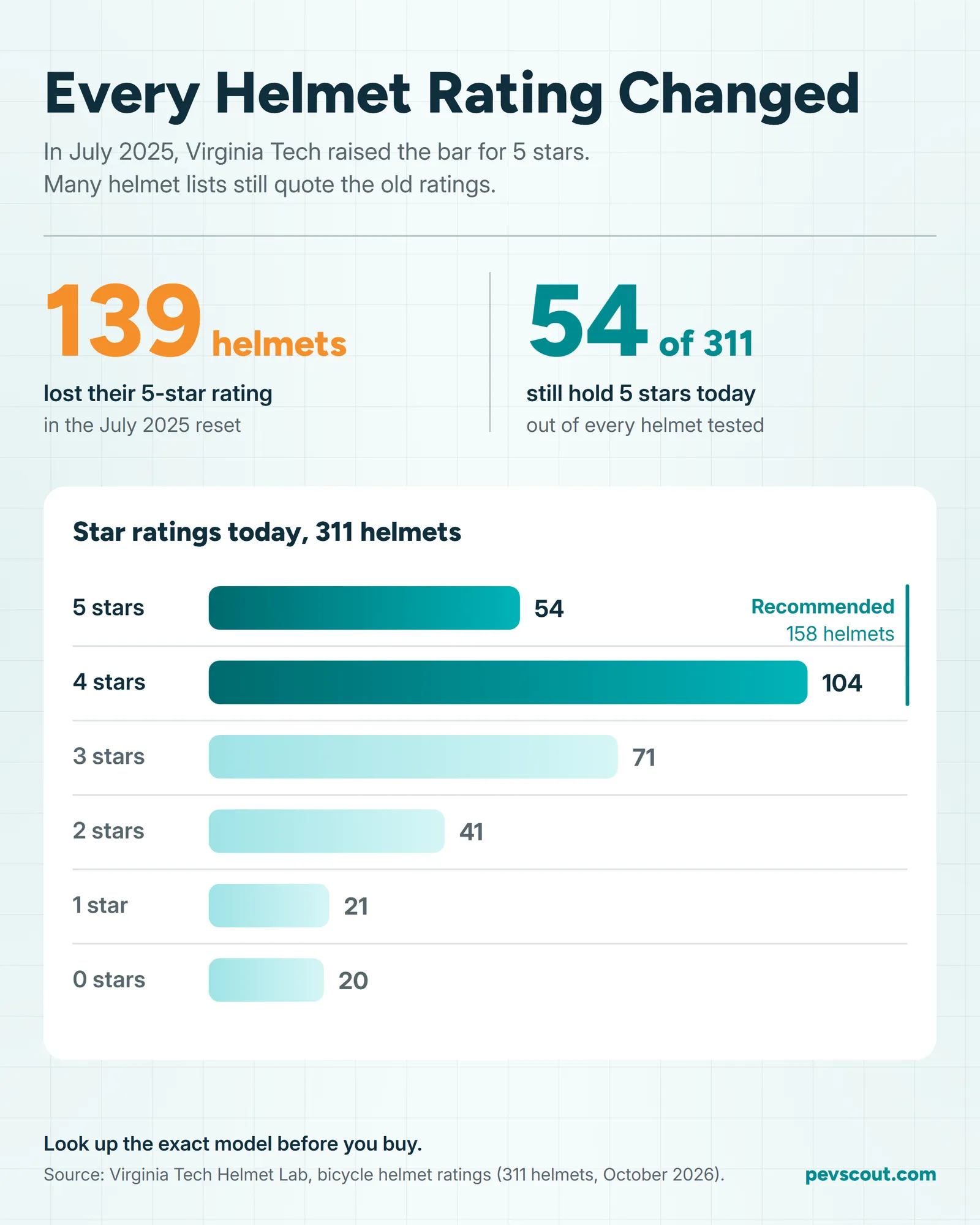
In July 2025 they reset the thresholds, and 139 helmets lost their 5-star rating. Helmets had genuinely improved, so the old scale had stopped separating anything: nearly everything mainstream was 5 stars. The new scale spreads the tested helmets across the full range: of the 311 on the list today, only 54 are still 5 stars.
Almost nobody updated. Brand pages, buying guides and the AI-written listicles that fill this search result are still repeating pre-2025 numbers, which is why you will see helmets described as "5-star rated" that now score 2. Every rating on this page was pulled directly from Virginia Tech in September 2026 and reflects the current scale. Every pick holds 4 or 5 stars, the level Virginia Tech itself recommends, and the 5-star helmets come first.
Two honest caveats. A low score does not mean a helmet is unsafe: every helmet here passes CPSC, which is legally required. Virginia Tech measures how far past that floor a helmet goes, so the real distinction is "meets the standard" against "measurably better than the standard". And it is one lab with one protocol, which is the best public evidence available rather than the last word.
What is MIPS?
This is the question new riders ask most, so here is the short version.
When you fall off, you rarely hit the ground straight on. You hit it at an angle. Your head stops, but it also twists, and that twisting is what causes concussion. A plain helmet handles the stopping and does very little about the twisting.
MIPS stands for Multi-directional Impact Protection System. It is a thin, low-friction liner inside the helmet that lets the shell rotate about 10 to 15 millimetres against your head during an impact, shedding some of the twist before it reaches your brain.
That is the whole idea. It adds a few grams and, these days, very little money.
Do you need to hunt for MIPS specifically? No. Several makers built their own versions: WaveCel (Trek and Bontrager), KinetiCore (Lazer), SPIN (POC), 360 Turbine (Leatt). The current expert position is that these all work and that no ranking between them is supportable. Virginia Tech's 5-star list contains MIPS, WaveCel and KinetiCore helmets side by side. So: have one of them, and stop worrying about which.
If the same helmet is sold with and without a rotational system, take the version that has one.
The certifications, and which ones actually mean something
CPSC 1203 is the floor, not a ranking. Every helmet legally sold as a bicycle helmet in the US meets it. It is pass or fail, tests a single impact, and tells you the helmet cleared the bar and nothing about how far it cleared it. Two helmets with identical stickers can perform very differently.
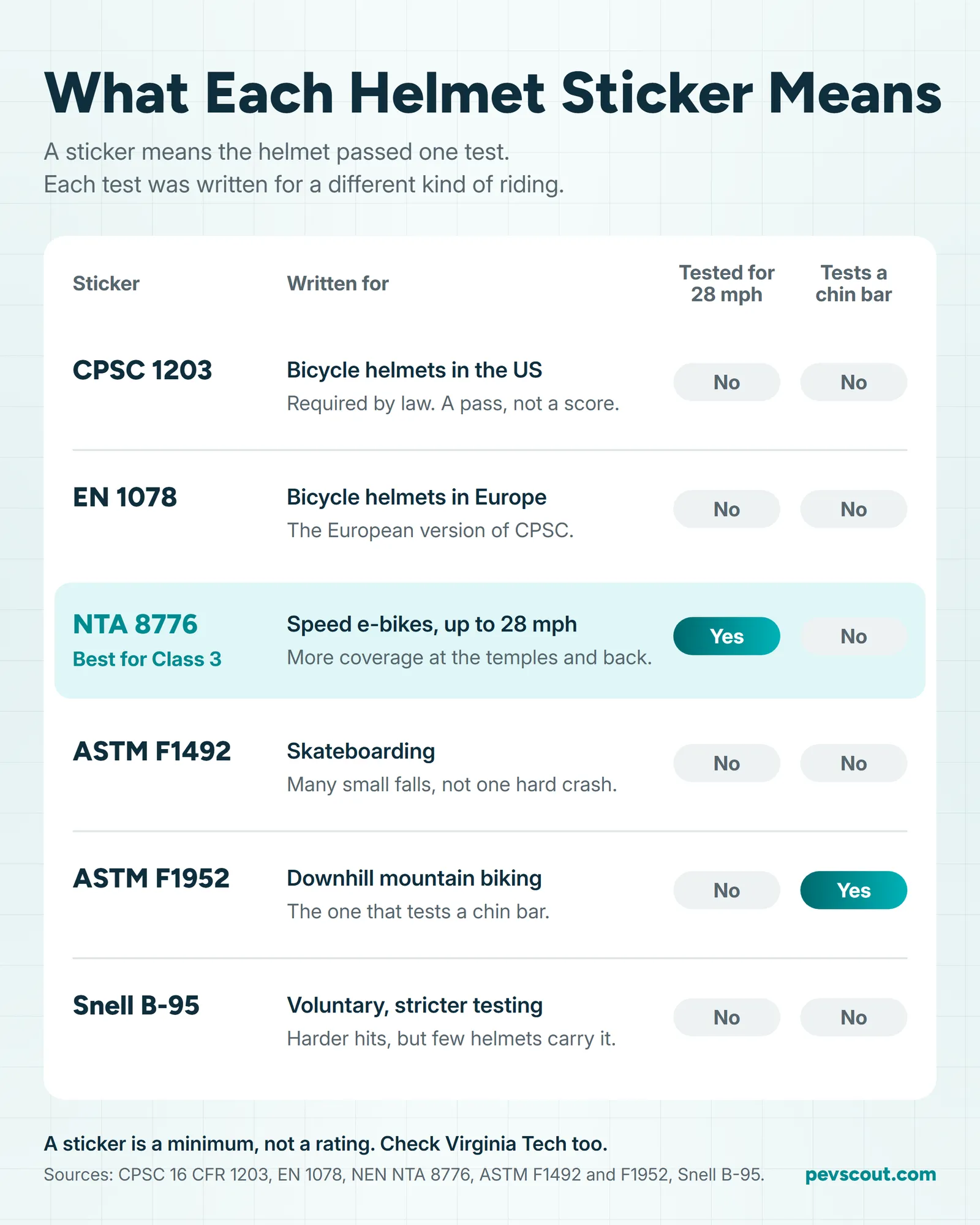
NTA 8776 is the one that matters most for PEVs. It is a Dutch standard written for speed pedelecs: tested to 45 km/h (28 mph), with more tested shell area at the temples and the back of the head than a bicycle standard demands. If you ride a Class 3, this is the single most relevant thing on the label. US distribution is thin, so its absence is not a red flag, but do not assume CPSC covers 28 mph riding. It was not written for it.
ASTM F1492 is the skate standard, and it is not the answer it looks like. CPSC tests one hard impact, on the assumption that you crash once and replace the helmet. F1492 tests multiple impacts, because skaters fall repeatedly in a session. That sounds like a match for scooter, one-wheel and e-skate riders, who tend to go down at lower speed but more often. The measured numbers say otherwise: the three dual-certified skate helmets Virginia Tech has tested score 1, 1 and 0 stars, and the two skate-shaped helmets that add NTA 8776 manage 3. Virginia Tech's test is built around cycling impacts and skate shells are not designed for it, which explains the gap without closing it. So we do not recommend a skate helmet here. If you ride a scooter, one-wheel or electric unicycle, look at a full-face instead: our full-face helmet guide compares the ones that score well.
ASTM F1952 is the downhill standard, and it is the only one that tests a chin bar. If you are looking at a full-face helmet, this is the certification to look for. More on that below.
EN 1078 is the European equivalent of CPSC. Lower drop heights, but a stricter g-force limit. Seeing it alongside CPSC is a mild positive, not a decisive one.
Snell B-95 subjects helmets to harder hits than CPSC over a larger area, but it is voluntary and very few helmets carry it.
Getting the fit right, which decides whether any of this works
Experienced riders say this before they say anything else, and they are right. A helmet that moves on your head redistributes an impact somewhere useless. One that pinches gets left at home. Neither protects you.
Measure first. Wrap a soft tape around your head about a centimetre above your eyebrows, at the widest point. That number in centimetres is what the size chart wants. Do not guess from hat size.
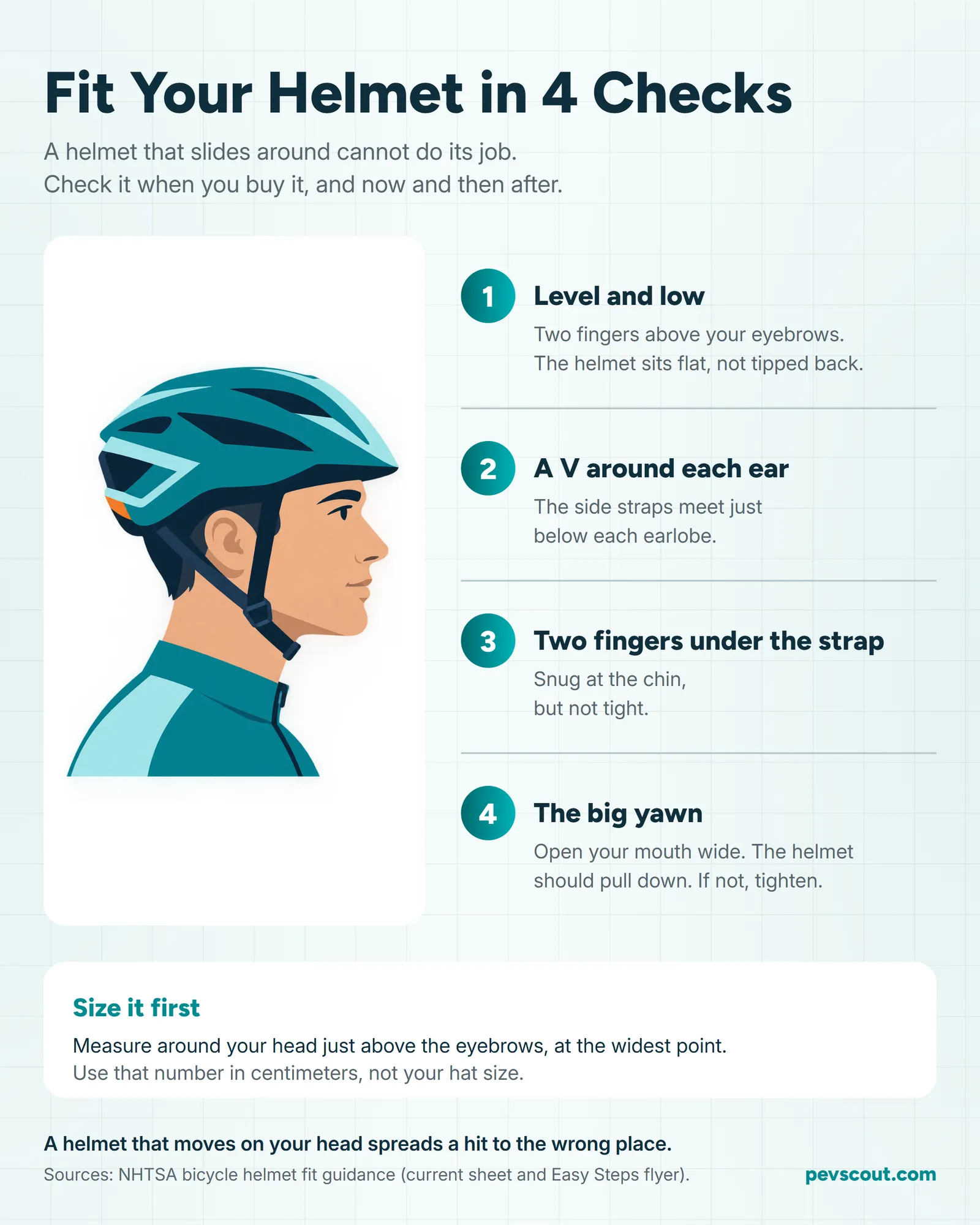
Then check four things on your head:
- It sits level, with the front edge about two finger-widths above your eyebrows. Tipped back is the most common mistake and it leaves your forehead bare.
- The side straps form a Y just under each ear, with the join sitting right below the earlobe.
- You can slide two fingers under the chin strap and no more.
- Shake your head hard. Nod, then side to side. The helmet should move your scalp with it. If the helmet slides independently, the size or the shell shape is wrong.
That last one is the real test. Every brand's shell shape is different, and pad swapping cannot fix a shell that is the wrong shape for your head. If you can try helmets on in person before buying, do that, even if you order online afterwards.
Match the coverage to how your vehicle throws you
A vented road helmet stops well above the ears and leaves the back of your skull comparatively exposed. Urban and skate shells drop lower at the rear and sides. At 15 mph that difference is academic. At 28 mph, or on a one-wheel where a rearward fall is the classic crash, it stops being academic.
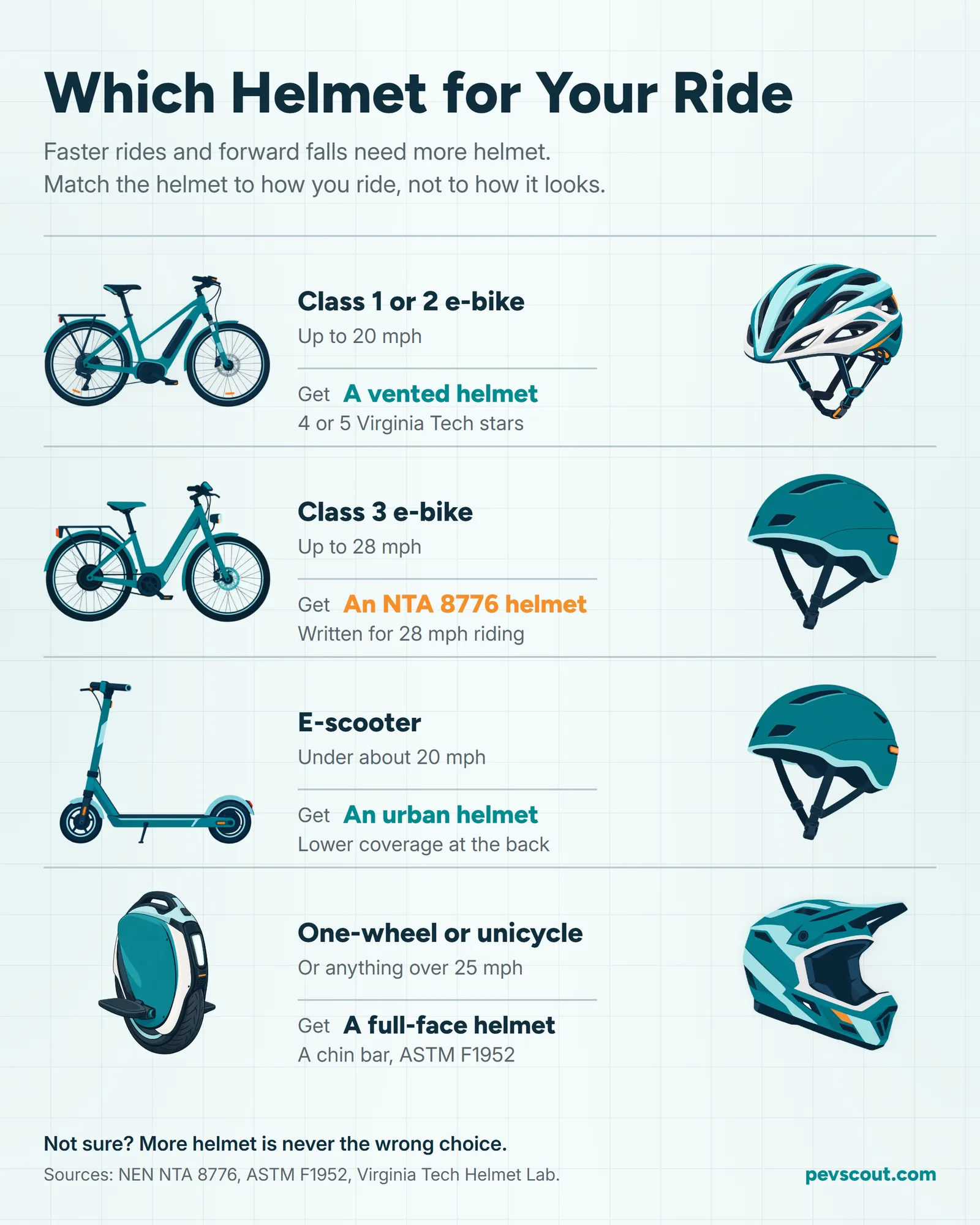
- Class 1 and 2 e-bikes, mostly pedalling: a good vented helmet is fine. Prioritise comfort so you keep wearing it.
- Class 3 e-bikes, 28 mph: look for NTA 8776 first, coverage second.
- Scooters under about 20 mph: any helmet on this page. Pick an urban shape for its lower coverage at the back, and skip skate helmets, which score poorly when measured (see above).
- One-wheels and electric unicycles: a full-face helmet. Our full-face helmet guide covers the ones that score well.
- Anything above about 25 mph: a chin bar, whatever you ride. See below.
Match the shape to how your vehicle actually throws you, not to what looks fastest.
Ventilation is a real trade, not a luxury
More vents means a cooler head and a lighter helmet, and less shell material. On an e-bike you are pedalling less and moving faster, so airflow is higher and your own heat output is lower than on an acoustic bike. That tilts the balance toward more coverage than a road cyclist would choose. If your commute is short, prioritise coverage. If you are climbing in summer heat, you will want the vents.
Lights, turn signals and smart helmets
A light on your helmet sits at the highest point on you, moves where you look, and is never the thing you left on the kitchen table. That is a genuine advantage over a bar-mounted light, not a gimmick.
Turn signals used to mean giving up measured performance, because the helmets that had them scored poorly. That changed: the UNIT 1 Aura holds a current 5-star rating with signals, a brake light and crash detection built in. If you want the electronics, you no longer have to trade safety for them.
Two warnings.
Bluetooth intercom helmets are a separate category. Sena's cycling helmets are the ones riders mention most, and they are genuinely good at what they do. But they are certified to CPSC 1203 and EN 1078 only, are not NTA 8776, and have not been tested by Virginia Tech. If group comms is the thing you want most, that is a legitimate choice, but know that you are buying an unmeasured shell.
Check which model you are actually looking at. Lumos, for example, sells several helmets under similar names: the plain Lumos Ultra scores 2 stars and is CPSC only, while separate Ultra E-Bike and Sonorus models carry NTA 8776. The names are one word apart and the specifications are not the same.
The cheap smart helmets you will find on Amazon
If you search for an e-bike helmet you will land on a wall of $40 to $90 helmets with LEDs, visors and rechargeable tail lights, from brands you have never heard of. Some are legitimately CPSC certified. The question is what the certification is worth.
Virginia Tech has tested a few of them, and the answer is: not much. Victgoal VG 112 scores 2 stars. Base Camp BC-019 and the Base Camp Urban Commuter both score zero. ILM's E3-12LS manages 2 stars even though it carries NTA 8776 certification.
That is not an argument for riding bare-headed. Any CPSC helmet beats none. It is an argument that the LED-and-visor feature list on a cheap helmet tells you nothing about how it performs, and that price is not the problem. The P2R A20 MIPS is also an unfamiliar brand selling a helmet with a rear light on Amazon, for about $60, and Virginia Tech ranks it 10th of all 311 helmets tested. Look the exact model up before you buy.
Lock ports and crash replacement
These sound like small conveniences and turn out to change behaviour. A helmet you can lock to the vehicle is a helmet that is with you when you need it, rather than left at home because carrying it around a shop is annoying. Thousand's PopLock is the best known; several makers now do a version.
Separately, a number of brands run crash-replacement programmes that discount a new helmet after a documented crash. Worth checking before you buy rather than after.
When to actually replace a helmet
You will read everywhere that a helmet expires after five years. That is a manufacturer line, and the evidence does not support it.
The Bicycle Helmet Safety Institute tested 675 used helmets, some of them 26 years old, and found that the EPS foam liner does not deteriorate with age. Sweat does not degrade it either: the standards do not permit a helmet that would degrade from sweat, and the foam is largely unaffected by salt water.
Here is what actually means replace it:
- Any real impact. Foam crushes once. A helmet that has taken a solid hit has spent its protection even when the shell looks fine. Multi-impact ASTM helmets are the only partial exception.
- Visible damage. Cracked or crushed foam anywhere. Crushed EPS springs back a little, so a dent that looks minor may not be.
- UV damage to the shell. Fading, or fine cracks around the vents, means the UV inhibitors are failing. This is the one that genuinely ages a helmet, and it is driven by sun exposure, not by the calendar.
Five years is a reasonable interval to think about upgrading, because helmets keep improving and a five-year-old helmet is probably beaten by something current. That is a different claim from "your helmet has expired", and the difference matters if the five-year line is what is stopping you from buying a good helmet today.
Do you need a full-face?
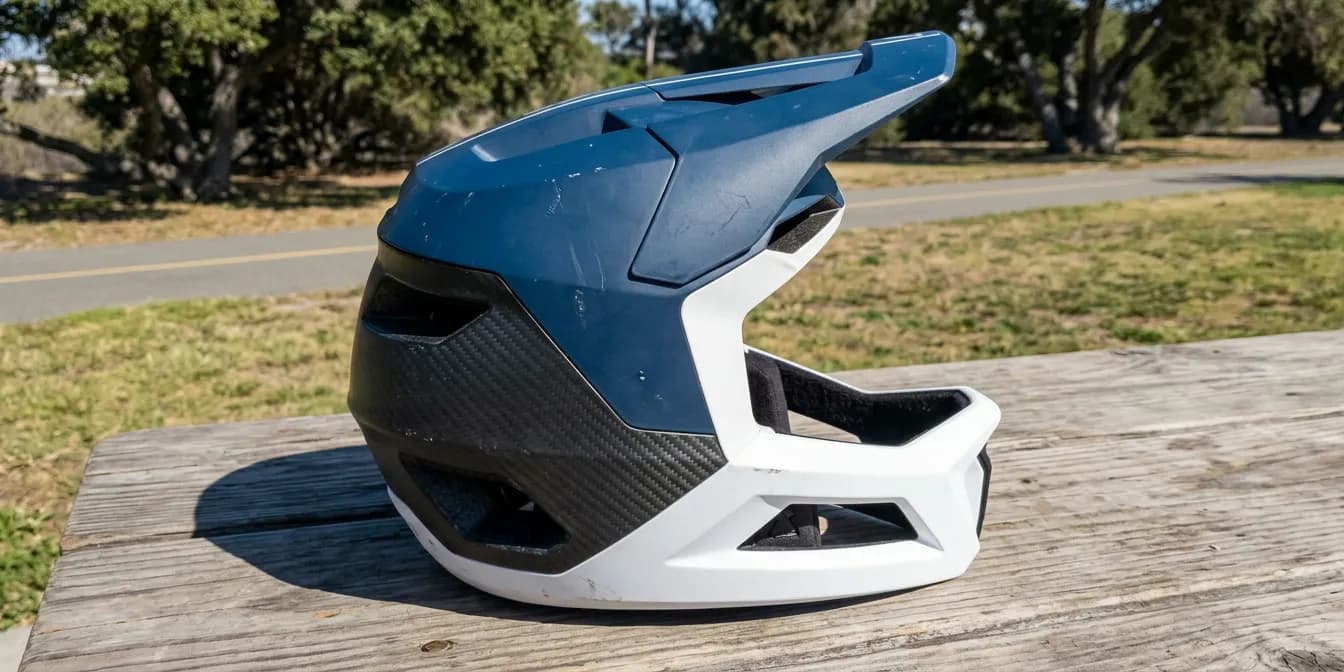
For some PEV riders, yes, and it is under-discussed. If you ride a one-wheel or electric unicycle, or a scooter you regularly take above 25 mph, this is where we would start, rather than with any helmet on this page. If you ride a scooter at commuting speed, an open-face helmet from this page is a sound choice, and the full-face guide is there if you want the extra coverage. Roughly half of electric-unicycle injuries involve the head or face, and no amount of star rating on an open-face helmet protects a jaw. The rule of thumb the EUC community uses travels well to fast scooters: under 20 mph a good bicycle helmet, 20 to 28 mph a downhill or NTA 8776 helmet, above 28 mph a motorcycle-certified helmet.
That is a whole separate decision with its own certifications, and it turns on one fact most guides miss: neither CPSC nor EN 1078 tests a chin bar at all. ASTM F1952 is the standard that does. If you are shopping for a full-face, that is the sticker to look for. Our full-face helmet guide compares the ones worth buying, with their Virginia Tech ratings.
Frequently Asked Questions
Do I legally need a helmet on an e-bike?
What is MIPS, in plain English?
What is NTA 8776 and do I need it?
Do bike helmets really expire after five years?
Are the cheap Amazon e-bike helmets with LEDs any good?
Can I just use a motorcycle helmet?
Looking to buy an electric ride?
We track 378 vehicles and check their prices every day. Start wherever suits you.
Type
Budget