Most PEVs ship with lights, and most of those lights are there to satisfy a regulation rather than to make you visible. They are usually a few tens of lumens, aimed vaguely, and wired to a battery that the manufacturer would rather you spent on range.
That is fine at 12 mph on a lit path. At 20 to 28 mph on a road, sharing space with drivers who are not expecting something that fast to be that small, it is not. A proper headlight and rear light is the cheapest meaningful safety upgrade you can buy, and it costs less than a tank of fuel.
Being seen matters more than seeing
There are two jobs a light does, and PEV riders usually need the second one more than the first.
Seeing is about putting usable light on the road ahead so you can read the surface and stop in time. This is what the lumen number is for, and it matters on unlit paths and at speed.
Being seen is about a driver at a junction noticing you exist and correctly judging how fast you are closing. Most PEV collisions are this failure, not a rider hitting an unseen pothole. And the daylight case is the one people skip entirely, even though a large share of crashes happen in good light. A daytime running flash is the single highest-value setting on a modern light.
What to look for
Treat lumen claims sceptically and look at runtime at that brightness. Lumens measure total light emitted, not how usefully it is aimed, and there is no enforcement of how makers measure it. A well-designed 800-lumen light with a shaped beam puts more light where you need it than a cheap 2,000-lumen one that throws a round blob into the trees and blinds oncoming traffic. More usefully, ask how long it holds that output. Many lights quote a headline number they can sustain for twenty minutes before stepping down hard. The number that matters is brightness at the end of your commute, not at the start.
A shaped beam is worth more than raw output on the road. Cheap lights use a simple round reflector, which wastes light upward into the eyes of everyone coming toward you and lights the sky rather than the tarmac. Better lights use a cutoff or shaped lens that concentrates the beam downward and forward, in a flat-topped pattern like a car's dipped headlight. You get more usable road, less glare, and you stop being the rider everyone flashes at.
Run a daytime flash, front and rear, every single ride. This is the change that costs nothing and does the most. A steady light disappears into a bright background, while an irregular flash is picked up by peripheral vision from much further away and reads as something moving. Almost every current light has a daylight-specific mode that is brighter and more attention-getting than the night flash. Use it in daylight and switch to steady, or steady plus a second flashing light, after dark, because a lone flashing headlight makes it very hard for a driver to judge your distance and speed.
Two rear lights beat one, and height beats brightness. The rear is where you get hit, and a rear light mounted on a seatpost is often blocked by a rack, a bag or your own body depending on the angle. A second light on the helmet or the back of a rack sits higher, is visible over cars, and moves with your head so you can aim it at a driver who has not seen you. Redundancy also covers the light you forgot to charge.
Rear-approach radar is a genuine category, not a gimmick. A radar tail light watches the road behind, and warns your phone or head unit when a vehicle is closing, along with how fast. It does not stop anything hitting you. What it changes is that you know a car is coming before you hear it, which changes how you position yourself in the lane and how relaxed the ride feels. It is expensive, and among the riders who try it very few go back.
Mounting and weatherproofing decide whether you keep using it. A light with a fiddly rubber-strap mount gets left on the bike and stolen, or gets taken off and forgotten at home. Check the mount works with your bar diameter, and with whatever else already lives there, since PEV bars get crowded fast with a display, a phone mount and a bell. Look for an IPX rating for rain, and prefer USB-C charging now that almost everything else you own uses it.
Check what your local law actually requires. Most places require a white front and red rear light after dark, some specify a minimum visibility distance, and a few prohibit flashing lights or restrict them to a supplement alongside a steady one. This varies by state and sometimes by city, and it is worth the two minutes to check rather than discovering it during a stop.
How we picked
Lumen figures, runtimes and features are each maker's published specifications, and we have not measured output or beam patterns ourselves. Radar behaviour is as documented by the manufacturer.
Our picks
| Product | Position | Output | Notable |
|---|---|---|---|
| KnogBlinder 1300Top pick | Front | 1300 lumens | Up to 120h on eco flash |
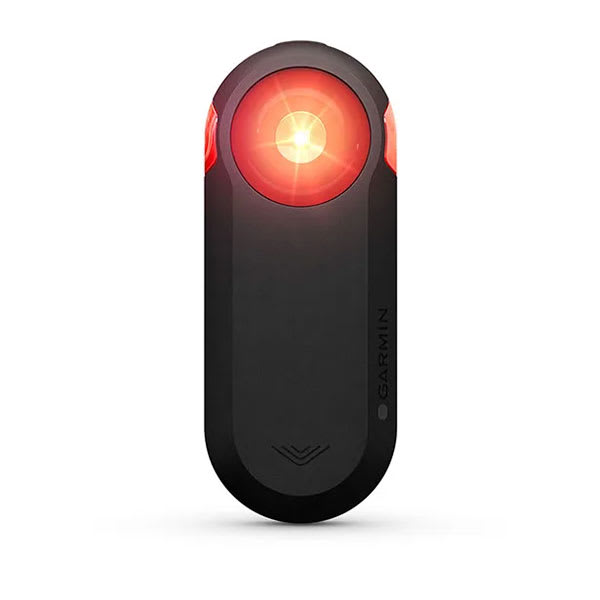
| GarminVaria RTL515Upgrade pick | Rear | 65 lumens | Rear-approach radar |
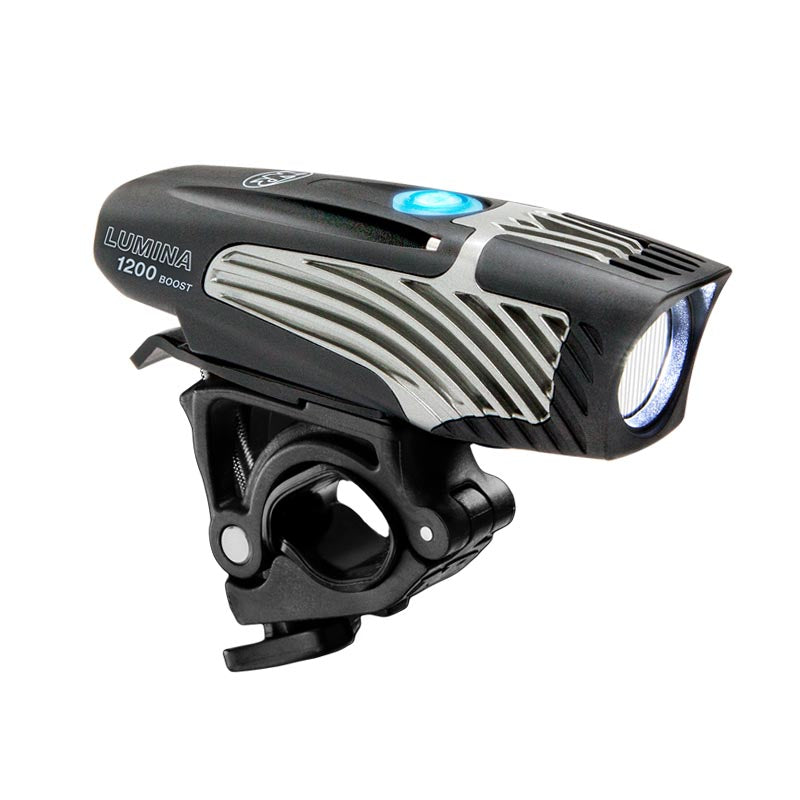
| NiteRiderLumina 1200 Boost | Front | 1200 lumens | Boost mode |
| NiteRiderSwift | Front | 500 lumens | Daytime mode |
| CygoliteDash Pro 600Budget pick | Front | 600 lumens | Three daytime running modes |
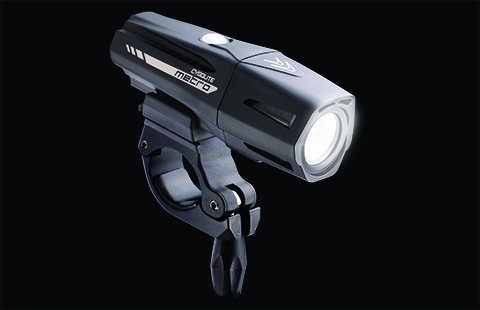
| CygoliteMetro Plus 800 | Front | 800 lumens | Daytime flash |
| KnogFrog Light Set | Front and rear | Low | Tool-free silicone strap |
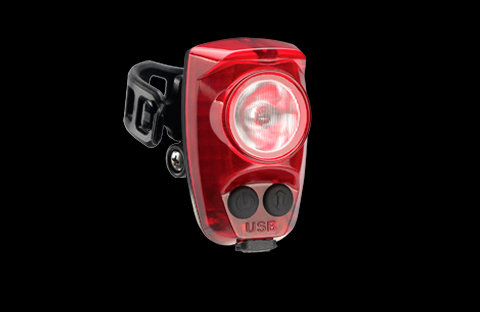
| CygoliteHotshot Pro 200 | Rear | 200 lumens | Adjustable flash patterns |
Knog · Lights
Blinder 1300
Standouts
- Strong beam with peripheral spill
- Huge runtime range
- USB-C charging
Trade-offs
- Full output only lasts about 90 minutes
A broad central beam with genuine peripheral spill, which is the thing that matters when you are moving fast enough that a pothole appears and leaves in the same second. The runtime range is the other draw: about an hour and a half at full solid output, out to roughly 120 hours on eco flash.
That spread means one light covers a dark commute home and a daytime flash for the ride in. Full output does not last a long ride, so treat 1300 lumens as the reserve rather than the setting.
Garmin · Lights
Varia RTL515
Standouts
- Warns you about traffic behind
- Bright daytime flash
- Works with phone or bike computer
Trade-offs
- Expensive for a tail light
- Radar needs charging like anything else
The Varia is less a tail light than a rear-approach radar that happens to blink. It pings your phone or bike computer when a car closes from behind, with distance and speed, and brightens as the car gets close. Riders who try radar rarely give it up.
It needs a head unit or phone mounted to be useful, and it costs like electronics rather than like a light. For riders on fast roads, it changes how safe riding feels.
NiteRider · Lights
Lumina 1200 Boost
Standouts
- Reliable mount
- Sustains usable output
- Long-standing commuter default
Trade-offs
- Round beam throws some light upward
The Lumina 1200 is the benchmark commuter headlight because it does the whole job: 1200 lumens is enough to actually light unlit paths, the mount survives potholes, and runtime at usable brightness is honest.
It charges over micro-USB rather than USB-C, showing the design's age. As a see-where-you-are-going light rather than a be-seen blinker, it remains the default recommendation.
NiteRider · Lights
Swift
Standouts
- Sized for city riding
- Daytime running mode
- Good value
Trade-offs
- Not enough output for unlit roads
Built for lit streets rather than dark trails, and priced and sized to be left on the bike. It has a proper daytime running mode, which on an urban commute does more for your safety than another 500 lumens would.
It is not enough light for unlit roads, and NiteRider does not pretend otherwise. If your riding is city and suburb, that is the correct amount of light and a smaller battery to carry.
Cygolite · Lights
Dash Pro 600
Standouts
- Three daytime running modes
- Enough output for unlit roads
- Cheapest serious light here
Trade-offs
- Smaller battery than the 1000-lumen lights
The value standout, and it earns it on features rather than price alone: three separate daytime running modes at a price where most lights offer one flash pattern and call it done.
600 lumens is the level where a light stops being purely about being seen and starts putting usable light on an unlit road. Combined with the DRL modes, this is the cheapest light here that genuinely covers both jobs. The battery is smaller than the 1000-lumen options, which is the trade.
Cygolite · Lights
Metro Plus 800
Standouts
- Good output for the money
- Proven daytime flash
Trade-offs
- Mount is less secure than the NiteRider
The Metro Plus 800 is the value standard: 800 lumens, USB rechargeable, and a daytime flash mode that gets attention in full sun. For riders who mostly need to be seen, with occasional dark-path duty, it covers everything for well under the premium lights.
The mount is more basic than the NiteRider's and peak runtime is shorter. Per dollar, nothing on this list is close.
Knog · Lights
Frog Light Set
Standouts
- Fits anywhere with no tools
- Ideal as a backup or second rear light
- Cheap enough to own several
Trade-offs
- Being-seen only, not for lighting the road
These are not for seeing the road. They exist so that a second set of lights lives permanently on a bag, a helmet or a seatpost, held on by a silicone strap with no tools and no mount.
That is worth more than it sounds. The rear is where you get hit, a seatpost light is often blocked by a rack or a bag, and the light you forgot to charge is the one you needed. Cheap enough to own several and never think about again.
Cygolite · Lights
Hotshot Pro 200
Standouts
- Very bright for a rear light
- Long runtime
- Adjustable flash
Trade-offs
- Bar-mount only without an adapter
The Hotshot Pro 200 is the rear light that made adjustable flash patterns standard: 200 lumens out back, tuned to whatever rhythm you find most visible, with runtimes measured in days of commuting.
It is a light only, with no radar or brake sensing. As the simple, bright, cheap rear that just works, it is an easy pairing with any front light here.
As an Amazon Associate, we earn from qualifying purchases.
Frequently asked questions
How many lumens do I actually need?
Should lights flash or stay solid?
Want to dig deeper?
Compare the picks in this guide side by side, or jump into the full database to filter on any spec.
More best of reads
The Best Helmets for E-Bike and PEV Riders
E-bikes and scooters go faster than the bikes most helmets were designed for. These picks favor real certifications, MIPS protection, and coverage that matches PEV speeds.
The Best Locks for E-Bikes
E-bikes are theft magnets, and thieves bring angle grinders now. Sold Secure ratings and grinder resistance are what separate real security from theater.

Fastest Electric Scooters for 2026: Top Speed Models Compared
The fastest electric scooters in 2026 reach speeds up to 68 mph, with top performers starting around $1,400 for 50+ mph models and $2,900+ for 65-68 mph peak speed.